China Top Textured Soy Protein Suppliers for Global Buyers?
Global buyers often consider China for Textured Soy Protein because manufacturers offer varied formats, protein levels, and packaging options. Yet a broad product range does not guarantee a good fit. Buyers should compare suppliers against the needs of their own applications, from meat alternatives and prepared foods to ingredient distribution. The details matter.
A useful supplier review begins with clear specifications. Check protein content, texture, moisture, particle size, and consistency between samples and commercial batches. Ask for current product data sheets, certificates, allergen information, and traceability details. Confirm production capacity, lead times, packaging choices, and export experience directly with each supplier. A responsive sales contact is helpful, but technical answers matter more. Samples matter, too.
This guide looks at Chinese suppliers through practical questions that international buyers can verify, rather than relying on promotional claims alone. It considers product range, quality-control practices, communication, and the ability to support repeat orders. No supplier is best for every buyer. A low quoted price may not reflect shipping costs, testing needs, or variation between batches. Even a polished website leaves questions unanswered. Buyers should request documentation, compare samples under their own processing conditions, and confirm specifications in writing before placing an order. Some details are easy to miss; that is worth admitting. Careful checks cannot remove every risk, but they can make supplier decisions more informed and dependable.
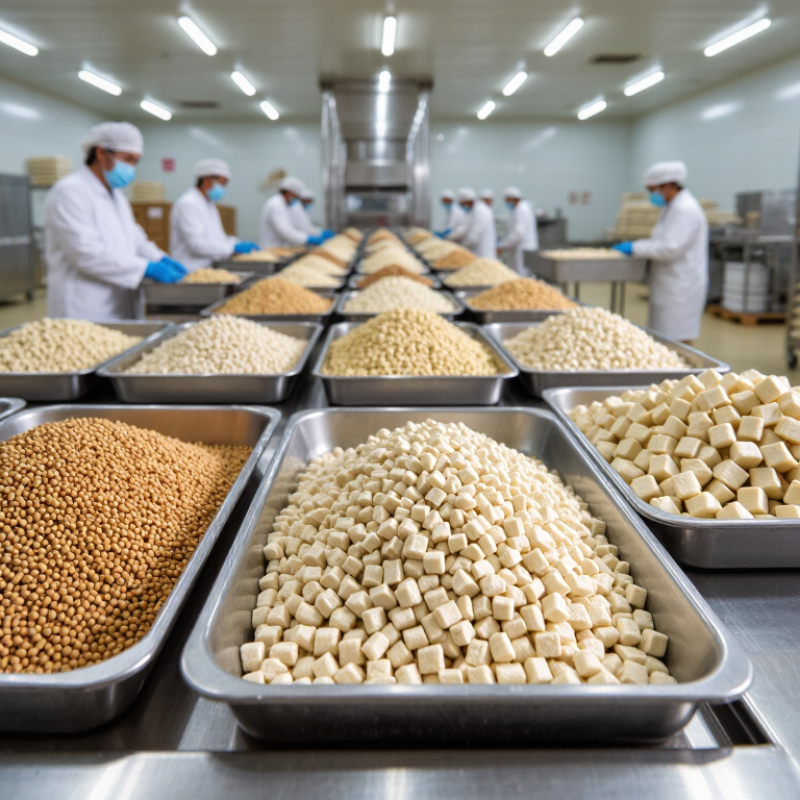
Textured Soy Protein Defined: Codex Soy Protein Flour Contains at Least 50% Protein
Textured soy protein is a structured soy ingredient, often made by extrusion from flour, concentrate, or isolate. Codex classifies soy protein flour as containing at least 50% protein on a dry basis, with less than 65%. That distinction matters. A flour just above the threshold is not nutritionally identical to a higher-protein concentrate.
For global buyers, the percentage is only one part of a useful specification. Ask suppliers for a current certificate of analysis showing protein basis, moisture, and relevant microbiological results. Check particle size, color, and hydration behavior against the intended product. In a test kitchen, small granules may absorb broth quickly, while larger pieces can need longer soaking. Not every batch behaves identically.
Processing also affects texture. Extrusion temperature, moisture, and pressure help create the fibrous bite, but the ingredient’s starting composition matters too. A clear specification should state whether protein is reported as received or on a dry basis. That detail is easy to miss. Compare samples using the same recipe and soaking time, then record yield and texture. Supplier documents help, but a bench test can still reveal surprises.
China Supplier Grades: Codex Sets Concentrates at 65–<90% and Isolates at ≥90%
China Top Textured Soy Protein Suppliers for Global Buyers?
For global buyers, protein percentage is a useful starting point when comparing textured soy products. Codex classifies soy protein concentrates at 65% to less than 90% protein, and isolates at 90% or more. These figures describe composition, not a complete performance grade. Check how the supplier reports protein, including the test method and moisture basis. Small differences in testing can complicate comparisons.
A higher protein figure does not automatically mean better texture in every recipe. Granules may need to hold their shape in a filling, while larger chunks should hydrate evenly without turning rubbery. Ask suppliers for a specification sheet, a recent certificate of analysis, and a sample for your own cooking test. Look closely at color, odor, water uptake, and texture after soaking. Numbers matter.
Some product listings leave the protein basis unclear. That is worth questioning, even when the quoted figure looks attractive. Request details on raw material, particle size, and recommended hydration conditions. Then compare samples using the same water temperature, soaking time, and cooking method. One practical test can reveal gaps a polished specification sheet misses.
How Chinese Suppliers Make TVP: Extrusion Uses Heat, Moisture, and Shear
For global buyers, textured soy protein is not defined by the ingredient list alone. Its bite depends heavily on how the extruder handles heat, moisture, and mechanical shear. Soy protein ingredients are fed into a barrel, where water hydrates the material as rotating screws mix and compress it. Temperature and pressure rise along the barrel. The protein structure changes, forming a cohesive mass. Small shifts show.
At the die, the hot mass expands as pressure drops. Die shape and cutting speed help determine whether the pieces become flakes, chunks, or finer granules. The product is then dried and cooled to support stable handling and storage. Too much moisture can weaken the final structure; too little may create a dense, uneven bite. That matters. Exact settings vary with the formulation and equipment, so a single recipe cannot suit every production line.
A careful supplier should be able to explain its process controls and provide relevant test data, such as moisture, protein content, and rehydration performance. Buyers can compare samples after soaking or cooking, noting firmness, color, and any lingering beany flavor. Ask whether results represent routine batches, not only a selected sample. This detail is easy to overlook. Even well-controlled extrusion has limits: texture can vary with raw material and operating conditions, and a specification sheet cannot replace a practical product trial.
Quality Verification: Codex Measures Soy Protein on a Dry Basis Using N×6.25
China Top Textured Soy Protein Suppliers for Global Buyers?
Quality Verification: Codex Measures Soy Protein on a Dry Basis Using N×6.25
For buyers comparing textured soy protein suppliers, protein claims need a consistent basis. Codex-oriented reporting expresses soy protein on a dry basis and estimates it by multiplying measured nitrogen by 6.25. This factor estimates crude protein; it does not directly measure every protein molecule. Moisture matters. A sample with more water can show a lower as-received percentage, even when its dry-basis value is similar.
Request the test method, sampling date, moisture result, and calculation basis with each certificate of analysis. Check whether the reported figure says “dry basis” or “as received.” Compare like with like. A composite sample from several bags can be more representative than a scoop from one open sack. Ask how samples were sealed and stored, since humidity can affect moisture readings. I would not treat one number as the whole story: texture, color, hydration, and batch consistency also affect performance in food applications. Even a polished certificate can reflect an unrepresentative sample.
Tips: Seek independent lab confirmation when results approach your specification limit. Keep retained samples from approved lots. Small checks help.
Soy Protein Quality Verification: Codex Dry-Basis Minimums
Codex calculates protein as nitrogen (N) × 6.25 on a dry basis.
Codex minimum protein contents are 50% for soy flour, 65% for soy protein concentrate, and 90% for soy protein isolate, expressed on a dry basis using N × 6.25. These are category thresholds, not supplier-specific results; verify textured soy protein against its declared category and product specification.
Global Sourcing Checks: Verify Textured Protein Classification Under HS 210610
Textured soy protein may fall under HS 210610, covering protein concentrates and textured protein substances. Treat this code as a starting point, not a confirmed answer. Classification depends on the product and the importing country’s tariff schedule. A sales description alone is not enough.
Ask suppliers for a current specification sheet, ingredient list, protein content, processing details, and a clear product description. Check whether the goods are defatted, blended with other ingredients, or prepared for a particular food use. These details can affect how customs authorities assess a shipment. Keep product labels, invoices, and technical documents consistent. Small wording differences can create avoidable questions.
Before placing a large order, compare the product documents with the relevant national tariff guidance. Where uncertainty remains, consult a qualified customs professional or seek an official classification decision. Do not rely only on a supplier’s code. Even a tidy document file can leave a gap if it describes the product differently from the goods shipped. That is worth checking.